 A mainstay of classic car restoration and maintenance workshops for decades pneumatically powered tools remain highly relevant despite the introduction of power driven or cordless alternatives.
Their popularity in recent years can be attributed to their compact size, and excellent power-to-weight ratio and overall robustness, making them particularly well suited to working on older vehicles, where access is often limited and materials may be fragile or irreplaceable.
Tools such as the pneumatic drill, right-angle air drill, air impact wrench (½″ drive), compact air impact wrench (⅜″ / ¼″), pneumatic ratchet, air screwdriver, and pneumatic tapping unit (air tapper) each offer specific benefits, but they also present notable drawbacks that must be understood to use them effectively.
 The pneumatically powered drill is particularly valued in restoration work thanks to its light weight, smooth operation and resistance to overheating. Unlike cordless or electric drills, air drills can run continuously without building any form of thermal stress, making them ideal for repetitive tasks such as drilling spot-weld holes, rivet holes, or panel-mounting holes. The relatively simple internal construction of the pneumatically powered drill also gives them long service life in dusty or metal-laden environments.
The right-angle air drill is especially useful when working inside engine bays, under dashboards, within door shells, or near chassis members. Its compact head allows access where straight drills simply cannot fit, while maintaining excellent control, reducing operator fatigue, and increasing its safe use in damp or oily conditions.
 The air impact wrench (½″ drive) is one of the most powerful tools in a classic car workshop, exceling in removing crankshaft pulleys, flywheel fasteners. seized suspension bolts, and wheel nuts that have not been disturbed for decades. The air impact wrench hammering action applies high torque in short bursts, often freeing fasteners without the need for heat.
 The major advantage of the air impact wrench is its sheer torque output combined with durability. Pneumatic impacts are lighter and often more compact than electric equivalents of similar power, making them easier to manoeuvre under vehicles or around suspension assemblies.
The compact air impact wrench (⅜″ / ¼″) bridges the gap between heavy impacts and hand tools, making them ideal for working on brake components, engine accessories, gearbox covers, and interior fasteners where moderate torque is required.
Providing excellent access in confined spaces, reduced risk of overtightening compared to ½″ impacts, and faster workflow than manual ratchets, and are particularly effective when dismantling engines or transmissions with numerous small bolts.
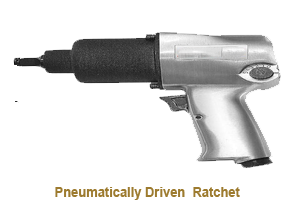
The pneumatic ratchet is one of the most versatile tools in restoration work, ideal for rapidly removing and installing bolts once they have been loosened manually, lending themselves to engine bay work, under-dash repairs, and trim removal are all areas where air ratchets significantly reduce fatigue and time.
 An air screwdriver is particularly valuable for interior restoration, electrical work, carburettor assembly, and light mechanical tasks, with its smooth operation and adjustable clutch allowing controlled fastening of small screws without stripping threads, making its key advantage being its ability to combine precision with speed, making it ideal for repetitive, low torque fastening. Air screwdrivers are also lighter than most electric equivalents and remain cool in continuous use.
The pneumatic tapping unit, regarded as a specialised but highly valuable tool in classic car restoration, enables accurate cutting of new threads in repaired panels, engine components, or brackets, particularly after welding or metal fabrication.
Advantages of the pneumatic tapping unit include consistent feed pressure, reduced tap breakage, and improved thread alignment compared with hand tapping, especially important when working with brittle castings or soft aluminium alloys commonly found in older vehicles.
Pneumatically powered drilling, fastening, and thread-work tools are well known and much appreciated, providing compactness, exceptional durability, compactness, and performance for classic car restoration. Their resistance to overheating and ability to operate safely in oily or damp environments make them particularly well suited to traditional workshops, although their effectiveness depends heavily on compressor capacity, air quality, and operator skill.
When used with care, and alongside hand tools for final adjustment, pneumatic tools remain an indispensable part of a professional classic car restoration and maintenance workshop.

- Pneumatically Powered Bodywork,Panel and Dent Repair Tools
- Pneumatically Powered Cleaning,Blowing and Degreasing Tools
- Pneumatically Powered Cutting,Grinding and Metal Removal Tools
- Pneumatically Powered Drilling, Fastening and Thread Work Tools
- Pneumatically Powered Mechanical and Service Tools
- Pneumatically Powered Paint, Coating and Finishing (Handheld) Tools
- Pneumatically Powered Riveting, Clamping and Assembly Tools
- Pneumatically Powered Sanding, Surface Preparation and Rust Removal Tools
- Pneumatically Powered Vibration, Impact and Specialty Tools
to4