 Beyond bodywork and paint, the long-term reliability and drivability of a classic car depend on careful servicing, taking in such important procedures as correct lubrication, accurate fluid management and precise engine machining to name just a few.
Pneumatically powered mechanical and service tools have long been valued in professional restoration workshops because they deliver consistent performance, fine control, and durability while reducing physical effort and improving workflow efficiency.
Any classic car restoration and maintenance workshop should have as full a set of specialist tools available to carry out these procedures with one of the most frequently used service tools is the pneumatic grease gun.
More than their modern-day versions, classic cars are more reliant on regular lubrication, particularly of their suspension joints, steering linkages, prop shafts, and chassis points—many more of which are found on modern cars.
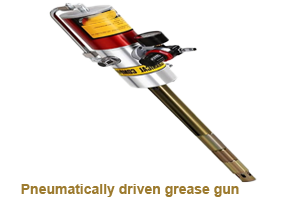 Pneumatically powered grease guns apply steady, controlled pressure, ensuring that grease is delivered evenly into bearings and bushes without sudden surges, reducing the risk of seal damage or incomplete lubrication, both of which can accelerate wear and tear.
Significantly reducing hand strain, pneumatic grease guns make routine servicing a much quicker and more consistent procedure, especially when it comes to vehicles with a large number of numerous grease nipples.
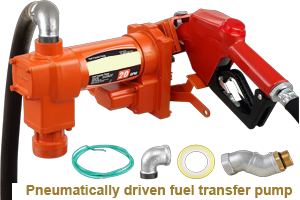 Fluid management is another essential aspect of restoration and maintenance, and the handheld air fluid extractor offers clear advantages, as they can maximise the power of compressed air to create vacuum, allowing oils, coolants or other fluids to be removed cleanly from engines, gearboxes, and hydraulic systems.
Pneumatic fluid extractors are particularly useful when it comes to draining systems where the possibility of gravity drainage is possible or when working on partially assembled vehicles. Their ability to control suction will reduce spilling, improve cleanliness and reduce the risk of contamination—critical when preserving rebuilt engines and freshly refurbished components.
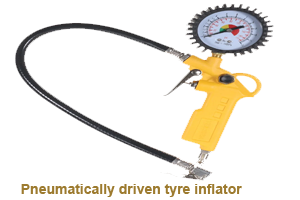
 >Tyre condition and pressure have a direct impact on safety, handling, and ride quality, especially on classic cars with period-correct tyres and suspension designs. An air tyre inflator with gauge provides fast, accurate inflation while allowing precise pressure adjustment.
In the classic car restoration and maintenance industry it is regarded that one of the key advantages of pneumatic powered tools is their reliability in harsh workshop environments. In restoration workshops that are often exposed to oil leakage, dust accumulation, excessive vibration and fluctuating temperatures, pneumatic tools have simpler mechanical designs with fewer components to fail, making them robust and long-lasting. Routine maintenance is straightforward, typically limited to lubrication and seal checks, which keeps downtime and operating costs low.
 >Workshop safety is another important consideration. Pneumatically powered service tools generate minimal heat and no electrical sparks, reducing fire risk when working around fuels, oils, and vapours, especially relevant during lubrication and fluid extraction tasks, where flammable substances are commonly present. The predictable, controlled operation of air tools also reduces the likelihood of sudden tool reactions that could damage components or cause injury.
From a workshop efficiency standpoint, pneumatic mechanical and service tools integrate seamlessly into a central compressed air system. Multiple service operations—lubrication, fluid extraction, tyre inflation, and engine machining—can be carried out simultaneously across different workstations. This shared infrastructure supports a smooth workflow, particularly during full restorations where mechanical systems are rebuilt and serviced in parallel.

- Pneumatically Powered Bodywork,Panel and Dent Repair Tools
- Pneumatically Powered Cleaning,Blowing and Degreasing Tools
- Pneumatically Powered Cutting,Grinding and Metal Removal Tools
- Pneumatically Powered Drilling, Fastening and Thread Work Tools
- Pneumatically Powered Mechanical and Service Tools
- Pneumatically Powered Paint, Coating and Finishing (Handheld) Tools
- Pneumatically Powered Riveting, Clamping and Assembly Tools
- Pneumatically Powered Sanding, Surface Preparation and Rust Removal Tools
- Pneumatically Powered Vibration, Impact and Specialty Tools
to4