During the Fifties and Sixties, the drum brake was the most commonly fitted braking system on British and European cars. Manufacturers such as Jaguar, Austin, Morris, Ford UK, Volkswagen, Peugeot and Volvo fitted drum brakes as standard on both front and rear wheels for many years before disc brakes gradually became common from the mid-Sixties onwards.
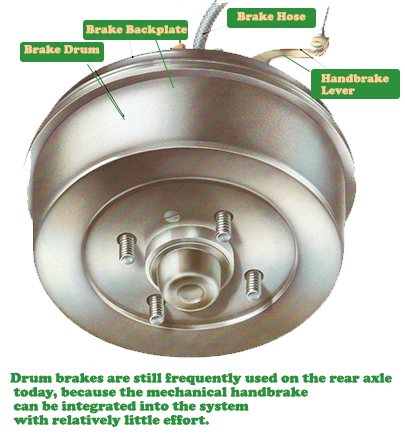 Even when disc brakes appeared on the front axle, drum brakes often continued to be used at the rear because of their simplicity and their ability to incorporate a mechanical handbrake.
A drum brake consists of several main components mounted on a brake backplate attached to the axle or suspension upright. The rotating brake drum, normally made from grey cast iron, is fitted over the wheel hub and rotates together with the wheel.
 Inside the drum are two curved brake shoes carrying friction brake linings. These shoes are held in position by springs and mounting pins on the backplate. When the driver presses the brake pedal, hydraulic pressure from the master cylinder travels through the brake pipes to a wheel cylinder mounted between the shoes.
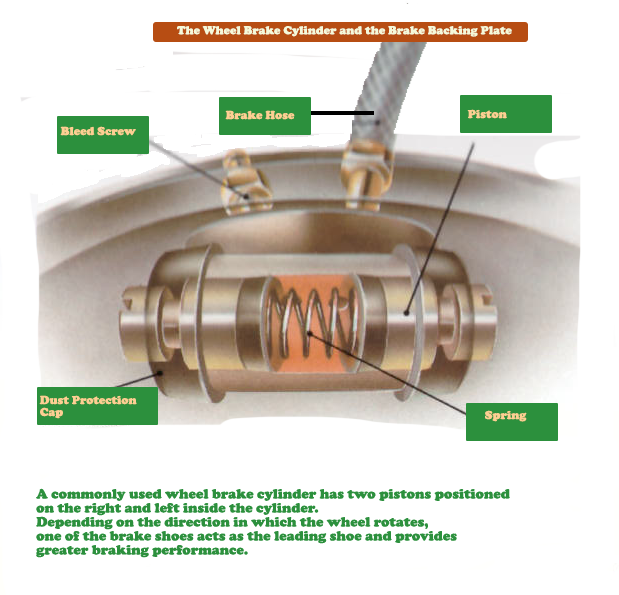
The wheel cylinder contains two small pistons which push the brake shoes outward. This forces the linings against the inner surface of the drum, creating friction and slowing the rotation of the wheel.
Return springs pull the shoes back when the pedal is released.
Most drum brake systems of the Fifties and Sixties used a leading and trailing shoe arrangement. In some designs, especially on front brakes, two leading shoes were used to improve braking efficiency when the vehicle moved forward.
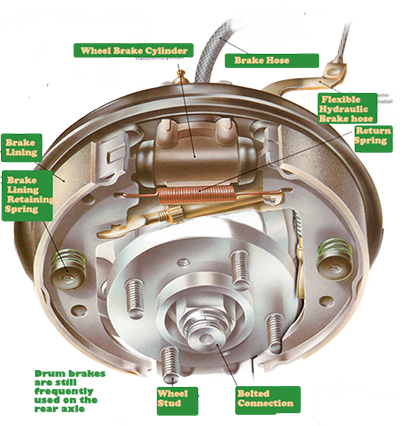
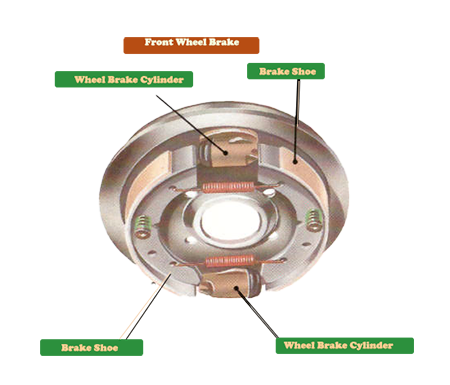 The main components of a drum brake are two brake shoes which are resiliently mounted on the backplate and carry the brake linings.
Between the two brake shoes on the backplate there are one or two hydraulic wheel cylinders and the operating lever for the mechanical handbrake.
When the brake pedal is pressed, hydraulic pressure is transmitted through the brake lines to the wheel cylinder. There the pressure forces the pistons apart, pressing the brake shoes with their linings against the inner running surface of the drum, thereby slowing or stopping the drum together with the wheel hub and the wheel.
 As the brake linings wear, the clearance between the drum and the lining increases. This causes the brake pedal to travel further and further until braking efficiency is reduced. Some vehicles are fitted with automatic adjustment mechanisms which adjust the brake shoes when the brakes are applied. In these systems no excessive clearance develops.
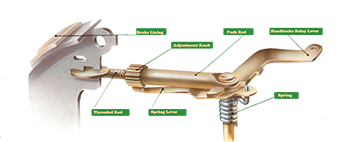
When the brake linings have become worn, the push rod and threaded rod are automatically relieved. This allows the spring lever to move the ratchet wheel, which in turn rotates the threaded rod, extending it from the push rod and thereby adjusting the brake automatically. The brake linings then sit slightly closer to the brake drum.
The leading shoe moves in the direction of rotation of the brake drum, which increases braking force. The advantage of this system is that regardless of the direction of rotation there is always one leading shoe providing higher braking performance.
Like all braking systems, drum brakes rely on friction. Over time the brake linings gradually wear down. As the lining thickness decreases, the gap between the drum and the shoe increases, causing the brake pedal to travel further before the brakes engage.
Heat is another factor. Repeated heavy braking can cause the drum to become hot and sometimes slightly distorted. Oil or brake fluid contamination can also reduce braking effectiveness.
Common reasons drum brake components need replacement include:
- Worn or thin brake linings
- Scored or worn brake drums
- Leaking or seized wheel cylinders
- Weak or broken return springs
- Contaminated brake linings from oil or grease
During the Nineteen Sixties a number of vehicle manufacturers began to introduce automatic adjusters designed to keep the shoe clearance correct, as earlier cars required manual adjustment.
A classic car owner should consider replacing drum brake components if any of the following symptoms appear:
- Excessive brake pedal travel
- Reduced braking performance
- Pulling to one side when braking
- Grinding or scraping noises
- Visible brake fluid leaks near the wheel cylinder
Regular inspection is essential, particularly on vehicles that have been stored for long periods.
Replacing drum brake parts is a routine maintenance job in classic car restoration and servicing.
First, the wheel is removed, and the brake drum is taken off the hub. If the vehicle has an automatic adjuster, it must be backed off before the drum will come free. Once removed, the condition of the shoes, springs and wheel cylinder can be inspected.
 Worn brake shoes should be replaced in pairs on the same axle. The return springs are often renewed at the same time, as they lose tension with age. If the wheel cylinder shows signs of leakage or corrosion, it should be replaced or rebuilt.
Before reassembly, the backplate contact points should be lightly lubricated with high-temperature brake grease. The drum is refitted, the brake adjustment set correctly, and the hydraulic system checked and bled if necessary.
Properly maintained drum brakes are vital for safe driving, especially if the car they are fitted to will be in regular use. Although simple in design, they require periodic inspection and adjustment. Replacing worn components ensures reliable braking performance and preserves the authenticity of the vehicle.

UB4