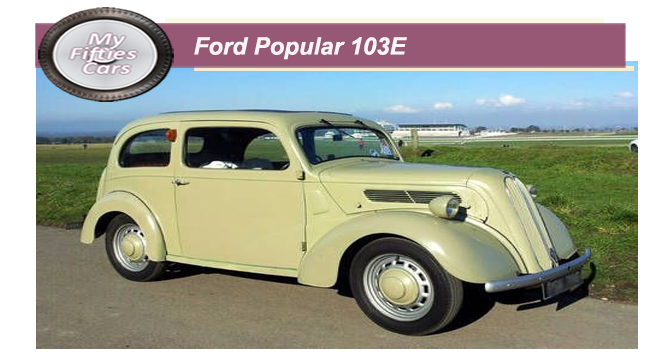
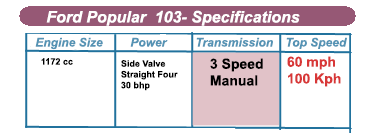
 When Ford of Britain needed a rock-bottom-price car to tempt austerity-weary buyers in the early 1950s, it turned to a familiar recipe: simple engineering, proven parts, and almost monastic equipment levels.
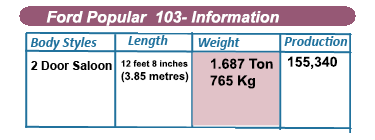
The result was the Ford Popular 103E, produced between 1953 to 1959 known n affectionately among the UK motoring population as simply the “Ford Pop.”
Conceived as the least expensive new car you could buy in Britain; it kept pre-war architecture alive well into the mid-century and put basic motoring within reach for thousands.
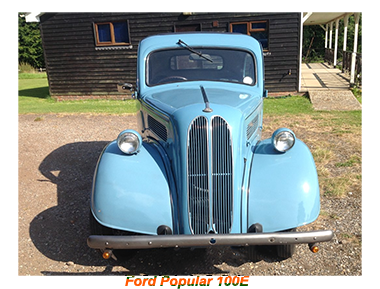
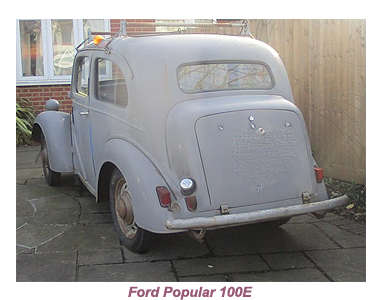 The 103E was succeeded by the “New Popular” 100E (1959–1962). Primary assembly was in the United Kingdom, drawing heavily on Ford’s Dagenham operations east of London, and the model was also assembled in Australia, where additional utility-style variants were offered.
The UK car market in the early Fifties was driven the six-year wartime production hiatus and years of rationing. Late-model used cars in any kind of good condition were few and far between while the biting export quotas imposed by the British Government to bring in valued foreign currency constrained new-car availability.
Despite these constraints, Ford UK were still able to offer reasonable numbers of 103E which came with a warranty and at a rock-bottom price!
 Buyers who were prepared to forgo luxuries (a heater was extra) and accept very basic engineering could drive away in a new Ford rather than gamble on an elderly pre-war saloon.

The 103E’s lineage evolved from the pre-war Ford 7Y/Model Y family, via the E04A and E494A Anglia, with the Popular taking the torch when the Anglia/Prefect lines were discontinued, retaining the Y’s separate chassis-style body construction cues, simple rod brakes, and suspension and steering layouts that were already antique in the Fifties—yet familiar to every small-garage mechanic in the land. The very conservatism of the specification was a virtue for cost and serviceability, and it helped the Popular earn a reputation for being nearly indestructible if treated kindly.
 Those who managed to raise the money to acquire a Popular quickly grew to appreciate the ease of home maintenance—a starting handle was provided, the choke was manual, and routine servicing points were accessible without special tools.
The car’s minimal electrics (6-volt) and thermosyphon cooling reduced component count, though they also placed limits on both night driving and high-load, hot-weather use.
Period road tests and owner accounts emphasised steady-state cruising at 45–50 mph, progressive braking, and ample following distances; driven that way, the Popular offered reliable, inexpensive mobility.
 For today’s classic-car enthusiast, the 103E represents an evocative time capsule of post-war UK and the British Commonwealth: straightforward to restore, well supported by clubs and specialists, and endlessly characterful.
Many survivors remain, because mechanical parts were easily interchangeable with other small Fords of the era, keeping a 103E on the road is rarely a sourcing headache.
And while performance is modest, the car’s lightness and proportions have also made it a cult favourite in Britain’s hot-rodding scene.
The very conservatism of the specification was a virtue for cost and serviceability, and it helped the Popular earn a reputation for being nearly indestructible if treated kindly.


Take me back to the home page
-