 In 1929 the Humber/Hillman partnership began a process which would see them become a part of the large UK-based car manufacturing concern the Rootes Group, eventually becoming a wholly owned subsidiary of the company in 1932.
Within a short time, Rootes launched two new models at Humber, the 2.1-liter six-cylinder 16/50 and the 3.5-liter six-cylinder Humber Snipe.
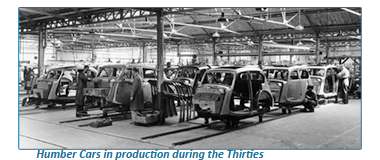 By the outbreak of World War II, Humber Cars had established a strong position at the top end of the market, thanks to their technical development as much their stylish bodies produced for them by Pressed Steel.
 Once again the company's production was devoted to the war effort, although this time around a number of Super Snipes as well as other variants were built for the British Army.
These Snipes were destined as staff cars, with the ultimate accolade coming from Commander-in- Chief of the British Army, Field Marshall Bernard Montgomery, who picked up a Humber Saloon to take him to the front line.
Apart from producing private cars during World War II, Humber were also responsible for the development of a number of specialist military vehicles, which they continue to build long after the war ended -Not only for the British Army but also for armed forces abroad, earning valuable export sales.
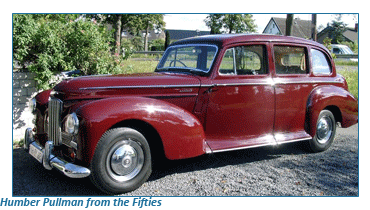 Throughout the Fifties, Rootes continued with their tried and tested policy of producing very few models, while replenishing them with constant updates.
This highly cost-effective system meant that, for the entire decade of the Fifties, with Humber’s whole production based on just three models, the Hawk, the Super Snipe and to a much lesser extent, the Pullman.
Going into the Nineteen Sixties, Humber served as the “senior” prestige brand within the Rootes Group, offering well-appointed, traditional executive cars targeted at business clients and official fleets.
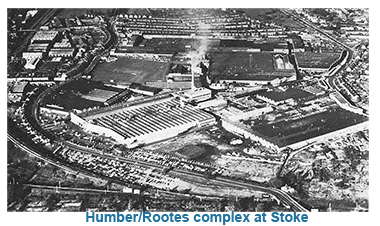 The enduring Coventry roots of Humber remained a significant part of the historic Humber/Rootes complex at Stoke, which includes Stoke Aldermoor, continued to play a vital role in engineering and manufacturing, while large-scale car assembly became increasingly focused on Rootes’ Ryton-on-Dunsmore plant located just outside Coventry.
 Prominent Humber models during the Sixties continued to be the Humber Hawk, with four versions produced during these years, under the labels from the 1960s and their production series II–IVA, selling between them close to twenty thousand until production of the model was discontinued in 1967
Humber also continued production of their long running Humber Super Snipe, a large six-cylinder flagship, clocking up around 17,000 sales during the Sixties.
 An ultra-luxury derivative of the Super Snipe. the Humber Imperial, was launched in 1964. Already showing its age, the model failed to take off and was discontinue in 1967.
 At the group level, the strategy and funding for Humber were determined by the leadership of Rootes: Lord Rootes, serving as chairman, and Sir Reginald Rootes, the deputy chairman.
In July 1962, Geoffrey Rootes, who had previously served as deputy chairman and managing director of Humber, took on the role of chairman and joint managing director, while Timothy Rootes was appointed as joint managing director of Humber.
Following the death of Lord Rootes in 1964 and during the rise of Chrysler's influence, Gilbert Hunt took on the role of managing director of the Rootes Group in 1967.
In March 1967, Rootes declared the cessation of production for the Hawk, Super Snipe, and Imperial models. The Humber brand persisted solely through the Sceptre, which marked the conclusion of the Humber name when it was discontinued in September 1976.