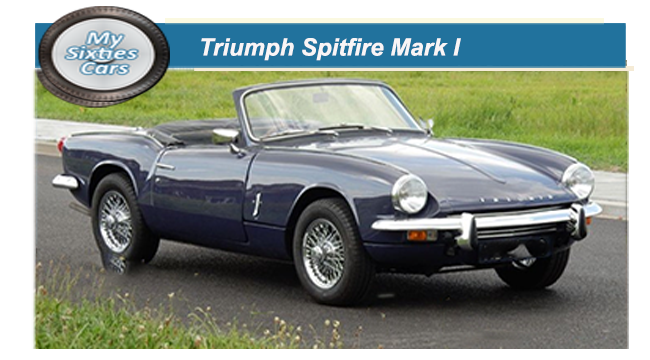
 The Triumph Spitfire is one of the most recognisable and beloved classic sports cars to emerge from the hot bed of sports car innovation that marked Britain during the Sixties.
Produced by Triumph in the years between 1962 and 1980, the Spitfire was designed to deliver affordable open-top motoring with a spirited driving experience.
Triumph brought in the well renowned Italian designer Giovanni Michelotti to handle all aspects of design and development for the Spitfire, that featured sleek, simple lines giving the vehicle timeless appeal.
The Spitfire’s compact dimensions, low stance, and distinctive front end made it instantly recognisable, while its lightweight construction contributed to agile handling and lively performance.
Powered by a series of small four-cylinder engines, ranging from 1.1 to 1.5 litres over its lengthy production run, the Spitfire was not exceptionally powerful, although the car’s low weight meant it delivered an engaging and responsive driving experience. The rear-wheel-drive layout and independent suspension further enhanced its reputation as a fun, driver-focused sports car.
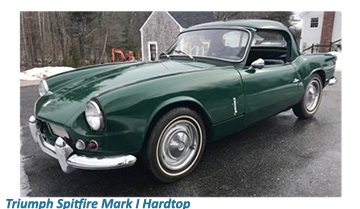 One of the Spitfire’s most notable design features was its forward-hinged bonnet, which lifted entirely to provide excellent access to the engine bay. Making maintenance and repairs a far simpler procedure than many of its counterparts of the era, contributing to its popularity among enthusiasts and amateur mechanics alike.
 The patriotically named Spitfire was Triumph's budget sports car, an intriguing alternative to BMC’s MG Midget and larger MGB sports cars.
All three models retained their popular throughout the Sixties, all of them continuing in production, albeit with modifications, for the next eighteen years.
 The Spitfire was another Triumph Herald-based offering, designed to compete with MG's Midget, which was proving to be a strong seller.
There had been plans for a sports version of the Herald since it took shape on the drawing board, but these were shelved until Triumph chiefs were presented with a sketch that ace designer Giovanni Michelotti had come up with for an attractive and low-cost compact roadster in 1960.
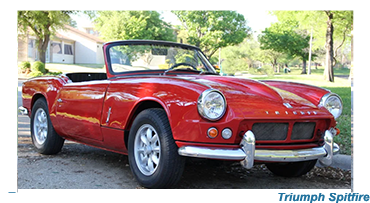 The Triumph Spitfire was based on the Triumph Herald saloon, which had a separate chassis that could be modified to carry a sports body without the need for expensive retooling.
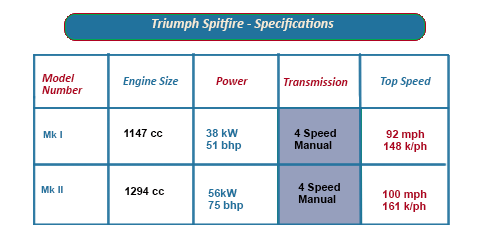
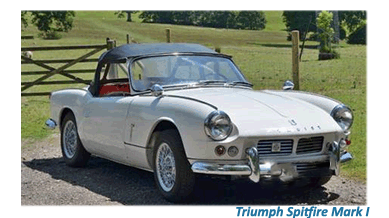
 This basic sports car had advantages – like a tilt-forward front end that offered excellent access to the 1.1-litre engine – and disadvantages like swing-axle rear suspension that was liable to cause violent oversteer.
The trim on the Spitfire was best described afundamental, with the only "luxury" feature being wind-up windows (unlike their contemporary Sprites and Midgets). Wire wheels and a hard top were available as options.
 The Triumph Spitfire went through several evolutions during its production run.Among them was the development of the coupé version, unlike the MGBs and Cs marketed as a separate model from 1966 to 1973.
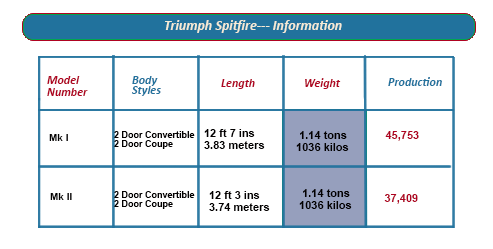
The Spitfire Mk II (1965-1967) was handed a relatively minor interim upgrade- the Mk III (1967-1970) a considerable facelift, including being equipped with a larger and more powerful engine.
The final major update came in 1974, when the Spitfire received a 1493 cc (91 cu in) engine, ironically the same as used in the 'rival' MG Midget.
Today, the Triumph Spitfire enjoys a strong following among classic car enthusiasts. Admired for its design and durability, the Spitfire remains an icon, a symbol of classic British motoring at its most enjoyable and approachable.


Back to the homepage- and don't spare the horsepower.