
In a classic car restoration and maintenance workshop, taking care of bodywork is a multi-functional role, much more than cutting and painting metal. A wide range of bodywork replenishment skills and the support tools to go with them play a crucial role in bonding materials, repairing trim, shaping panels, sealing joints and preparing surfaces for finishing.
In recent years, cordless technology has transformed how these tasks can be carried out, making them easier through providing flexibility, portability and safety, Situations that combine to suit both full restorations and ongoing maintenance work.
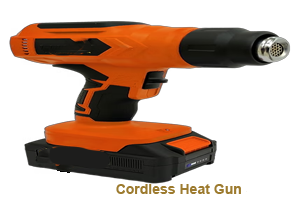 The cordless heat gun among the most versatile support tools used in bodywork. In classic car restoration, it is commonly used for paint stripping, vinyl removal, adhesive softening, seam drying, and controlled panel shrinking. When fitted with appropriate nozzles and used carefully, a heat gun can help shrink stretched steel panels after dent repair, particularly on older body shells made from relatively soft, low-carbon steel.
Cordless models eliminate trailing cables around sharp panels and freshly painted surfaces, allowing technicians to move freely around the vehicle.
The cordless heat gun is found to be especially valuable in tight spots such as inside engine bays, boot compartments, door frames, or on a rotisserie, providing rapid heat-up times and stable temperature control factors that make the cordless heat gun more than suitable for both light trim work and more demanding metal-shaping support tasks.
Cordless glue guns have become indispensable in trim fitting, temporary panel positioning, upholstery repairs, and interior restoration. In bodywork, they are often used to temporarily hold mouldings, badges, wiring looms, vapour barriers, or trim panels in place before final fixing.
 For classic vehicles, where original mounting points may be fragile or irreplaceable, the controlled use of hot-melt adhesive allows reversible and non-invasive solutions. Cordless operation is particularly useful when working inside cabins, headliners, or door cards, where power outlets may be inconvenient or unsafe. Modern cordless glue guns heat quickly and maintain consistent flow, enabling precise application without excess adhesive that could damage original materials.
 A specialist tool increasingly used in plastic repair, particularly for bumpers, interior trim panels, heater boxes, and under-dash components found in later classic cars, the cordless hot stapler heats metal staples, which are then embedded across cracks or fractures in plastic parts to reinforce and stabilise them.
In restoration work, this factor has become invaluable in the increasing instances that original plastic components are either no longer available or prohibitively expensive to replace.
Cordless hot staplers allow repairs to be carried out directly on the vehicle without extension leads, reducing the risk of damaging surrounding paint or trim. Once reinforced, the plastic can be filled, sanded, and refinished to near-original appearance, preserving authenticity while restoring structural integrity.
Seam sealing is a critical but often overlooked aspect of bodywork. With classic cars relying heavily on factory seam sealers to prevent corrosion, and vibration, with these seals having borne that stress for half a century or more, a cordless caulking or seam sealer gun allows accurate and consistent application of modern sealants that replicate and often improve original finishes.
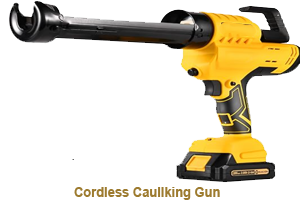 A cordless caulking or seam sealer gun are used when sealing floor pans, bulkheads, wheel arches, boot seams, door frames, and welded joints. Battery-powered guns provide steady pressure, producing uniform beads that are difficult to achieve by hand, especially with thicker sealants. This improves both appearance and durability while reducing hand fatigue during large restoration projects. Cordless operation is particularly beneficial when working underneath vehicles or inside confined areas where manoeuvrability is limited.
Accurate paint preparation is essential for high-quality bodywork. A cordless paint mixer, usually a paddle attachment driven by a cordless drill or dedicated mixer, ensures thorough blending of primers, topcoats, clear coats, and seam sealers.
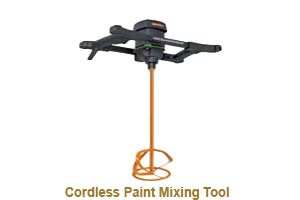 In classic restoration, where small batch mixing is common to match original colours or apply period-correct finishes, cordless paint mixers offer speed and consistency without tying up mains power tools. They are ideal for mixing in paint booths, mobile workstations, or remote areas of a workshop. Proper mixing ensures uniform pigment distribution, correct viscosity, and consistent curing, all of which are critical to achieving a professional finish on restored body panels.
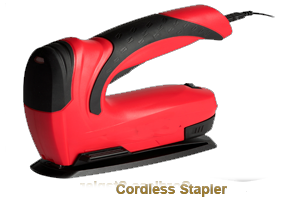 Widely used in interior and trim-related bodywork tasks, including upholstery fitting, headliners, carpets, door cards, sound deadening and wooden body framing on older vehicles, the cordless stapler or Nailer is a must to have. A large number of classic cars still remain reliant on stapled or nailed fixings that must be replicated accurately during restoration.
Cordless staplers provide controlled fastening without compressors or hoses, making them ideal for working inside cabins or on partially assembled vehicles. Adjustable power settings make it simple for staples or brads to be driven securely into fragile plywood, fibreboard, or original trim materials with a minimal risk of damage, making for improved efficiency while maintaining the craftsmanship required in concours-level restorations.
Cordless bodywork support tools have become essential assets in the modern classic car restoration and maintenance workshop. From heat-based metal and trim work to sealing, bonding, mixing, and fastening, these tools enhance precision, safety, and workflow efficiency. Their portability is especially valuable when working on complex body shells, confined interiors, or rotisserie-mounted vehicles. When used thoughtfully, cordless support tools help restorers preserve originality, improve build quality, and carry out bodywork tasks with greater confidence and control—an ideal combination for safeguarding the legacy of classic automobiles.

- Battery (cordless) powered Drilling, Driving, Fastening Tools
- Battery (cordless) powered Cutting, Grinding, Metal Shaping Tools
- Battery (cordless) powered Sanding, Surface Preparation, Rust Removal Tools
- Battery (cordless) powered Polishing, Detailing, Finishing Tools
- Battery (cordless) powered Bodywork Support Tools
- Battery (cordless) powered Electrical and Wiring Tools
to4