Lying at the very heart of any classic car restoration and maintenance project is the issue of bodywork and panel repair. Unlike modern vehicles, older cars often feature thicker steel, hand-formed panels, lead loading, and construction methods that demand careful, sympathetic repair rather than outright replacement.
Pneumatically powered body tools have long been favoured in professional workshops for their controllability, durability, and efficiency. Tools such as the pneumatic hammer / air chisel, air body hammer (low impact), air dent puller / stud gun, air flange & punch tool, and air shrinking hammer each play a distinct role in reshaping and repairing original metalwork
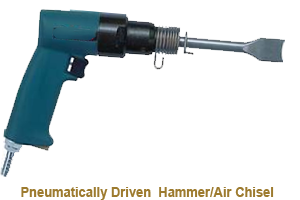 Among the most powerful tools used in classic car body repair is the pneumatic hammer, sometimes referred to as an air chisel. The pneumatic hammer is commonly employed for removing rusted panels, separating spot welds, cutting away corroded sections, and dismantling previously bodged repairs.
The primary advantage of an air chisel is its effectiveness, delivering rapid, repeated blows that make short work of stubborn seams, heavy corrosion, or old under seal. Thanks to its ability to interchange between chisels, panel splitters, and spot-weld cutters increases the air chisel’s versatility, allowing targeted material removal with minimal physical effort.
The air body hammer (low impact) is a more refined pneumatic tool designed for controlled metal shaping rather than demolition. It is widely used for panel straightening, crease reduction, and fine metal movement during dent repair.
Invaluable when access to the rear of a panel is restricted, an air dent puller, especially when combined with a stud gun, operates by welding small studs to the panel surface, then pulled outward to restore the original contour.
 The major advantage of an air dent puller is its minimal intrusion, thanks to lack of necessity to remove interior trim or cut access holes, preserving original structures, especially useful for repairing quarter panels, sills and complex body sections common in classic cars of the Fifties and Sixties.
 The air flange & punch tool is a staple in panel replacement and repair work. It creates stepped flanges for lap joints and punches precise holes for plug welds, replicating factory spot welds.
Due to its combined advantages of precision and repeatability, pneumatic operation produces clean, uniform flanges and holes, improving panel fit and weld quality, particularly important when fabricating repair sections for arches, floors and sills, where alignment and strength are critical.
 The air shrinking hammer is a specialised tool used to reduce stretched metal by concentrating controlled blows in a specific area, often in conjunction with heat. It is particularly useful for correcting oil-canning or warped panels.
A key advantage of the air shrinking hammer is its efficiency. When compared to traditional heat-and-hammer shrinking, the air shrinking hammer speeds up the process and reduces physical strain, allowing restorers to address stretched areas without excessive grinding or filler application.
Pneumatically powered bodywork, panel, and dent-repair tools provide a long list of undeniable benefits in classic car restoration and maintenance, improving productivity, reducing operator fatigue as well as enabling consistent, repeatable results—particularly in demanding metal-shaping tasks.

- Pneumatically Powered Bodywork,Panel and Dent Repair Tools
- Pneumatically Powered Cleaning,Blowing and Degreasing Tools
- Pneumatically Powered Cutting,Grinding and Metal Removal Tools
- Pneumatically Powered Drilling, Fastening and Thread Work Tools
- Pneumatically Powered Mechanical and Service Tools
- Pneumatically Powered Paint, Coating and Finishing (Handheld) Tools
- Pneumatically Powered Riveting, Clamping and Assembly Tools
- Pneumatically Powered Sanding, Surface Preparation and Rust Removal Tools
- Pneumatically Powered Vibration, Impact and Specialty Tools
to4