 Electrically powered drilling tools, that can also handle fastening and thread repair, play a crucial supporting role in any classic car restoration and maintenance workshop.
While manually operated hand tools continue to maintain an essential role, corded electric tools have taken up a dramatic share of the market by consistently providing accuracy, and efficiency, a welcome trait when dealing with stubborn fasteners, structural repairs or repetitive operations. When used correctly, electrically powered drilling tools, enhance productivity without compromising originality or care.
Electrically powered drilling tools, that can also handle fastening and thread repair, play a crucial supporting role in any classic car restoration and maintenance workshop.
While manually operated hand tools continue to maintain an essential role, corded electric tools have taken up a dramatic share of the market by consistently providing accuracy, and efficiency, a welcome trait when dealing with stubborn fasteners, structural repairs or repetitive operations. When used correctly, electrically powered drilling tools, enhance productivity without compromising originality or care.
Electrically powered drilling tools, the corded electric drill is the backbone of any restoration workshop. Powered directly from the mains, the corded electric drill delivers constant torque and speed without battery limitations. Most corded electric drills s feature variable speed triggers and reversible motors, allowing drilling as well as light fastening duties.
The corded electric drill is driven by an electric motor through a gearbox, which turns the chuck so that it will accept drill bits, wire brushes, sanding discs or polishing accessories. 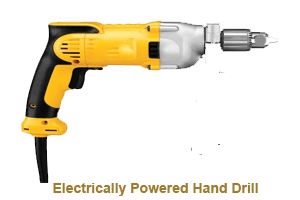 In classic car restoration and maintenance products, corded drills are ideal for drilling spot welds, removing seized screws, cleaning threads with rotary wire brushes, and drilling accurate holes in steel, aluminium, wood, and fibreglass. The consistent power of electric drill makes them especially useful when working on thicker chassis sections or hardened fasteners common on older vehicles.
Whilst possessing most of the attributes of a corded electric drill the right-angle drill is designed to work in confined spaces where a standard drill will be difficult to fit.
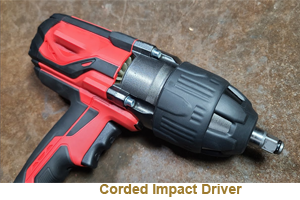
The right-angle drill operates through a compact gearbox that redirects the motor’s rotation through 90 degrees, allowing drilling and fastening in tight areas. Right-angle drills are ideal for drilling mounting holes behind bulkheads, inside door frames, or within boxed sections—tasks that would otherwise require awkward hand drilling or component removal. 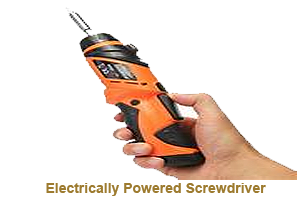 A corded impact driver is a handy tool to have in any classic car restoration and maintenance work thanks to its ability to deliver high torque through rapid rotational impacts.
 Providing low to medium torque with precise control, the electric screwdriver operates through a compact motor driven by a clutch-controlled gearbox, often with adjustable torque settings. The advantage of the electric screwdriver is when attaching interior trim, dashboard fittings, carburettor screws, and any form of light electrical work. Electric screwdrivers speed up repetitive tasks while reducing wrist fatigue.
 Thread repair is a common requirement in a classic car restoration and maintenance workshop, especially when working on engine blocks, suspension mounts and gearbox casings. Electric tapping machines improve accuracy, reduce broken taps, and ensure clean, square threads—critical when repairing irreplaceable original parts.
Electric tapping machines operate by rotating taps or dies at controlled speeds, often with auto-reverse to prevent breakage.
Designed for controlled stud extraction and refitting, an electric stud remover/installer is a must to have around in a classic car restoration and maintenance workshop.
 An electric stud remover/installer operates through torque being applied through either rollers or collets that grip the stud without damaging threads.
Classic car engines frequently suffer from seized or broken studs, which can be alleviated by electric stud tool removal that allow smoother removal with less risk of snapping studs or damaging cast iron and aluminium housings—often saving hours of repair work.
An electric stud remover/installer operates through torque being applied through either rollers or collets that grip the stud without damaging threads.
Classic car engines frequently suffer from seized or broken studs, which can be alleviated by electric stud tool removal that allow smoother removal with less risk of snapping studs or damaging cast iron and aluminium housings—often saving hours of repair work.
The electrically powered rivet gun provided the ability to automate blind rivet installation.
Operated through an electric motor that pulls the mandrel smoothly until the rivet sets, then ejects the broken mandrel.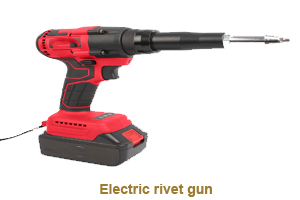 Useful for body panels, heat shields, trim brackets, and interior fittings, electric rivet guns provide consistent clamping force without hand strain, making them especially valuable when working solo or when the project calls for installing large numbers of rivets during panel fabrication.
Electrically powered drilling, fastening, and thread repair tools bring controlled power and efficiency to the classic car restoration workshop. Used alongside hand tools, they reduce fatigue, improve accuracy, and protect original components from damage. For restorers balancing authenticity with practicality, these tools represent a modern complement to traditional craftsmanship—enhancing productivity while respecting the mechanical integrity of vintage vehicles.

to4