Electrical systems are among the most sensitive and historically significant elements of any classic car.
While traditional manually operated hand tools remain important, hand-held electrically powered wiring tools have transformed how restorers diagnose, repair, and recreate electrical systems. These tools improve accuracy, reliability, and repeatability while reducing physical strain and the risk of damage to delicate components.
In classic car restoration, hand held electrically powered soldering irons are usually the tool of choice used for repairing wiring joints, attaching terminals, restoring instrument clusters, and refurbishing switches and relays. Controlled heat prevents insulation shrinkage and damage to period-correct wiring insulation, such as PVC or cloth-braided coverings. Compared with older, uncontrolled irons, modern electric soldering irons produce cleaner, more reliable joints, essential for long-term electrical reliability.
An electric soldering iron uses an internal heating element to raise the temperature of a metal tip, allowing solder to melt and bond electrical conductors. Temperature-controlled models enable precise heat regulation, which is essential when working with fine wires or vintage components.
 Invaluable in classic car electrical restoration, particularly when working on original fuse boxes, gauges, voltage regulators and control units that must be preserved rather than replaced, electric desoldering guns allow components to be removed without damaging fragile circuit boards or terminals. They significantly reduce the risk of lifted traces and heat damage, making them indispensable when refurbishing rare or irreplaceable electrical assemblies.
An 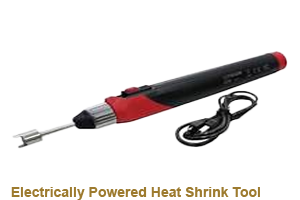 electric heat-shrink tool uses controlled hot air generated by an internal heating element and fan to shrink heat-shrink tubing evenly around wires and connectors. Unlike open flames, electric tools deliver consistent, adjustable heat.
In a classic car workshop, heat-shrink tools are essential for insulating soldered joints, sealing crimped terminals, and protecting wiring from moisture and vibration. Even heat distribution prevents scorching and ensures professional-looking finishes. This is particularly important when recreating wiring looms, where neatness and durability must coexist with period authenticity.
 Classic car wiring often uses thinner conductors and older insulation materials that can be brittle or uneven. Electric wire stripping machines provide consistent results while reducing hand fatigue and the risk of damaged conductors. This is especially beneficial during full loom replacement or when preparing multiple wires for fuse boxes, lighting circuits, or dashboard assemblies. Cleanly stripped wires improve both electrical performance and mechanical reliability.
An electric wire stripping machine uses motor-driven blades or rollers to remove insulation cleanly from wires without nicking the conductor. Adjustable settings allow it to accommodate different wire gauges and insulation types.
Classic car wiring often uses thinner conductors and older insulation materials that can be brittle or uneven. Electric wire stripping machines provide consistent results while reducing hand fatigue and the risk of damaged conductors. This is especially beneficial during full loom replacement or when preparing multiple wires for fuse boxes, lighting circuits, or dashboard assemblies. Cleanly stripped wires improve both electrical performance and mechanical reliability.
An electric wire stripping machine uses motor-driven blades or rollers to remove insulation cleanly from wires without nicking the conductor. Adjustable settings allow it to accommodate different wire gauges and insulation types.
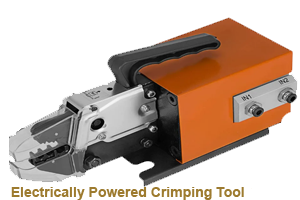 An electric crimping tool uses a powered mechanism to compress terminals onto wires with consistent pressure. Many models feature interchangeable dies for different connector types, including open barrel, insulated, and non-insulated terminals.
In a classic car restoration and maintenance project, correct crimping is just as important as soldering. Electric crimping tools ensure uniform compression, producing gas-tight connections that resist corrosion and vibration, at consistency levels which is difficult to achieve with manual crimpers, particularly when working with multiple connectors. Electric crimpers are ideal for reproducing factory-style wiring harnesses while ensuring modern reliability standards are met.
Especially valuable when recreating or repairing wiring looms in classic cars, where appearance is as important as function, electric loom wrappers allow restorers to reproduce original loom finishes—such as cloth tape or modern protective sheathing—quickly and consistently. The result is a neat, professional loom that is protected from abrasion and heat while maintaining a period-correct appearance.
An 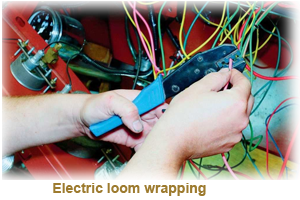 electric loom wrapping machine applies tape, braid, or split conduit evenly around wiring looms using a motor-driven wrapping mechanism. Tension and overlap are controlled automatically, resulting in uniform coverage.
Hand-held electrically powered wiring tools offer significant advantages in the restoration and maintenance of classic vehicles. They improve precision, reduce physical strain, and allow restorers to work methodically on fragile electrical systems. Electric operation ensures consistent heat, pressure, and motion—critical when dealing with ageing materials and rare components.
Ultimately, electrically powered wiring tools support the meticulous craftsmanship that defines high-quality classic car restoration. By combining traditional techniques with controlled, modern technology, they allow restorers to preserve originality while delivering dependable, professional results that stand the test of time.

to4