Surface preparation is one of the most critical stages in classic car restoration. Paint quality, corrosion resistance, panel fit, and long-term durability are factors that depend on how well existing finishes, rust, and contaminants are removed.
Hand-held electrically powered sanding and rust-removal tools have been developed to provide consistency, control, and efficiency while allowing restorers to work sympathetically with the ageing metal and original panels that have been left. Used correctly, sanding, paint preparation and rust removal tools combine to complement traditional hand methods while greatly reducing labour and fatigue.
The random orbital sander is a very important tools in pre-paint preparation. Ideal for removing old paint, feather-edging repairs, flattening primer, and keying surfaces before repainting in classic restoration, the random orbital sander’s precise action lowers the risk of damaging thin panels and helps keep the original steel strong, which is often much thinner than modern car bodywork.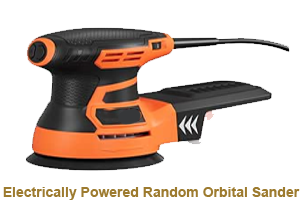 Powered by a round sanding pad that moves in both a spinning and an oscillating way, but not in a straight line, that prevents directional scratch marks and makes swirl patterns less noticeable.
For smaller and less challenging jobs, the palm finishing sander is a handy tool to have around. Ideal for getting into tight spaces such as door shuts, engine bays, interior panels, and trim areas, the palm finishing sander, because they are small, they can sand accurately without damaging nearby parts, making them ideal for detailed work on classic car bodies.
The palm finishing sander is operated by using a small square or rectangular pad that moves back and forth slowly and is controlled by simple hand pressure.
Powered by a round sanding pad that moves in both a spinning and an oscillating way, but not in a straight line, that prevents directional scratch marks and makes swirl patterns less noticeable.
For smaller and less challenging jobs, the palm finishing sander is a handy tool to have around. Ideal for getting into tight spaces such as door shuts, engine bays, interior panels, and trim areas, the palm finishing sander, because they are small, they can sand accurately without damaging nearby parts, making them ideal for detailed work on classic car bodies.
The palm finishing sander is operated by using a small square or rectangular pad that moves back and forth slowly and is controlled by simple hand pressure.
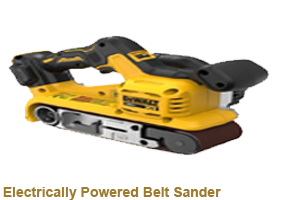 The belt sander is a quick and effective way to remove surplus material in a pre-paint preparation process.
Ideal for shaping things in restoration work, such as dressing welded seams, flattening steel repairs, or shaping brackets. When used correctly,the belt sander makes metalworking more efficient while preventing heat from building up, which can cause panels to bend.
The belt sander process uses an abrasive belt that runs all the time and moves quickly over rollers.
The belt sander is a quick and effective way to remove surplus material in a pre-paint preparation process.
Ideal for shaping things in restoration work, such as dressing welded seams, flattening steel repairs, or shaping brackets. When used correctly,the belt sander makes metalworking more efficient while preventing heat from building up, which can cause panels to bend.
The belt sander process uses an abrasive belt that runs all the time and moves quickly over rollers.
 For the tight spaces that need to be prepared for paint, the Mouse Sander usually provides answers to any problems. Classic cars have a lot of hard-to-reach places, like window frames, door skins, dashboards, and interior recesses. The mouse sanders make such arduous tasks as removing paint and rust from places that bigger tools can't reach. Operated by a small triangular pad that moves back and forth, the Mouse Sander making it easy to get into corners and tight spaces.
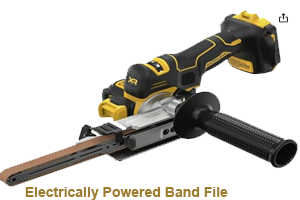 The power band file, basically a narrow belt sander, are necessary for cleaning edges, shaping brackets, deburring cut metal, and refining welds.
Especially helpful when working in the tight spaces that are common in classic cars, like the chassis rails, suspension brackets, and other structural areas, the power band file is operated by a thin abrasive belt that moves over a small nose roller, allowing for precise linear sanding.
Using non-woven abrasive discs or drums, the electric surface conditioning tool work very well to get rid of paint, underseal, rust, and oxidation on the surface while leaving the base metal underneath intact. The electric surface conditioning tool is especially efficient at retaining stamped details, seams, and the original panel thickness, as it motor turns in such a way that is meant for cleaning, not for cutting metal aggressively.
The power band file, basically a narrow belt sander, are necessary for cleaning edges, shaping brackets, deburring cut metal, and refining welds.
Especially helpful when working in the tight spaces that are common in classic cars, like the chassis rails, suspension brackets, and other structural areas, the power band file is operated by a thin abrasive belt that moves over a small nose roller, allowing for precise linear sanding.
Using non-woven abrasive discs or drums, the electric surface conditioning tool work very well to get rid of paint, underseal, rust, and oxidation on the surface while leaving the base metal underneath intact. The electric surface conditioning tool is especially efficient at retaining stamped details, seams, and the original panel thickness, as it motor turns in such a way that is meant for cleaning, not for cutting metal aggressively.
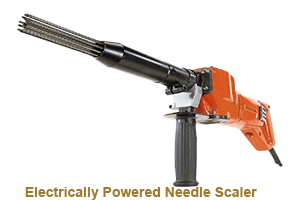 The electric needle scaler was designed to remove heavy corrosion quickly and easily using several steel needles that move back and forth quickly to get rid of rust and scale.
Needle scalers are an excellent tool for eradicating layers of rust on chassis rails, suspension mounts, and underbody sections. Unlike grinding, needle scalers remove all traces of rust without damaging sound metal, making them great for preserving structures.
The electric needle scaler was designed to remove heavy corrosion quickly and easily using several steel needles that move back and forth quickly to get rid of rust and scale.
Needle scalers are an excellent tool for eradicating layers of rust on chassis rails, suspension mounts, and underbody sections. Unlike grinding, needle scalers remove all traces of rust without damaging sound metal, making them great for preserving structures.
Hand-held electrically powered sanding, paint preparation, and rust removal tools play an essential in the modern classic car restoration maintenance workshop. Each tool serves a specific role, allowing restorers and maintainers to work efficiently while preserving originality.
Used with care and restraint, these tools help strike the crucial balance between modern productivity and traditional craftsmanship, ensuring classic vehicles are restored not just beautifully, but sympathetically and sustainably.
to4