 In a classic car restoration and maintenance workshop, manually operated spanners rank among the most vital and commonly utilised tools. The reason for this remains that classic cars vehicles were designed and produced during an era when mechanical assemblies depended heavily on hand-fitted fasteners, and their frequent employment demanded mixed thread standards and softer materials compared to those used in contemporary cars.
Consequently, the meticulous application of torque, exact fit, and tactile feedback are essential. Although powered tools have their uses, as any experienced restorer or maintainer will tell you, the advantages on manual spanners remain significant- to safeguard original components, maintain fasteners, and achieve precise, period-appropriate craftsmanship.
Having a comprehensive assortment of spanners on hand enables the restorer to tackle the diverse range of fasteners they may encounter with confidence.
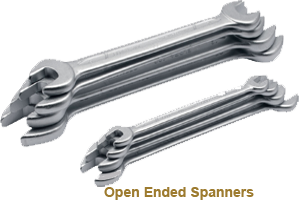 Open-ended spanners are essential tools in any traditional workshop. Providing access to fasteners in areas with limited clearance such as carburettor linkages, brake adjusters and steering components thanks to their slim jaws, open-ended spanners are especially beneficial when a nut needs to be adjusted incrementally because of limited mobility.
Typically featuring varying sizes on each end, double-ended spanners offer the option of both versatility and efficiency. In restoration work, double-ended spanners come into their own during dismantling and reassembly processes, especially when dealing with various fastener sizes, minimising the need for tool changes and enhances the efficiency of methodical work.
Open-ended spanners are essential tools in any traditional workshop. Providing access to fasteners in areas with limited clearance such as carburettor linkages, brake adjusters and steering components thanks to their slim jaws, open-ended spanners are especially beneficial when a nut needs to be adjusted incrementally because of limited mobility.
Typically featuring varying sizes on each end, double-ended spanners offer the option of both versatility and efficiency. In restoration work, double-ended spanners come into their own during dismantling and reassembly processes, especially when dealing with various fastener sizes, minimising the need for tool changes and enhances the efficiency of methodical work.
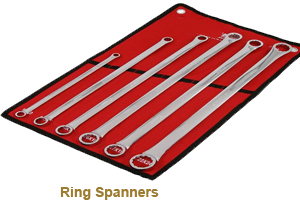 Ring spanners, often referred to as box spanners, present the advantage of completely encasing the nut or bolt head, thus ensuring that force is distributed uniformly around it. Ring spanners are particularly suitable for dealing with stubborn, corroded, or original fasteners where it is crucial to prevent rounding.
In classic car restoration and maintenance, ring spanners are commonly utilised when working on engine mounts, suspension fixings, and chassis bolts that may have remained untouched for decades.
In many cases, a ring spanner will have different sizes at each end but a combination spanner will have the same size of open-end and ring, one at each end, which makes them some of the most versatile tools available in the workshop. Combination spanners feature both an open end and a ring end of the same size. The open end serves to position or initiate fasteners, whereas the ring end is utilised for the final tightening or loosening process. The dual functionality of combination spanners renders them essential for routine maintenance and restoration assembly tasks.
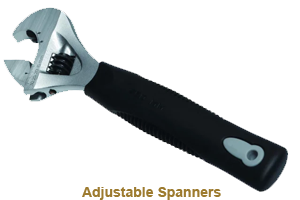 Adjustable spanners provide versatility when addressing non-standard, damaged, or unfamiliar fasteners, typical situations often encountered in classic vehicles undergoing restoration or maintenance that may have undergone modifications over the years. Although adjustable spanners may not offer the same secure grip as fixed-size spanners, they become very relevant when called upon to grip large nuts, locknuts, or fittings when the appropriate size spanner is not at hand. In adept hands, adjustable spanners will prove to be invaluable for light-duty tasks and for securing secondary fasteners while tightening.
 Specialist tubular tools crafted to completely encase a fastener, box spanners are frequently utilised in conjunction with tommy bars. In classic car restoration and maintenance projects, box spanners have consistently proven to be particularly beneficial for tasks involving spark plugs, exhaust manifold nuts, and various fasteners situated on long studs or in recessed spaces. The box spanner design facilitates even torque application while ensuring that hands remain clear of nearby obstructions.
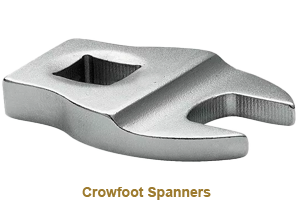 Crowfoot spanners are specialised tools that are utilised alongside extensions and torque wrenches. Essential for reaching fasteners in tight spaces where a standard spanner cannot be directly applied, crowfoot spanners are frequently utilised when working on fuel fittings, gearbox linkages and steering components. The crowfoot spanner’s open design facilitates manoeuvring around pipes and obstructions while maintaining controlled torque application.
Girder spanners are robust tools specifically engineered for handling large fasteners and high-torque tasks. In a classic car workshop, girder spanners these components are frequently utilised on suspension pivots, chassis bolts, differential mountings, and axle assemblies. The strong construction of the girder spanner enables precise application of force without bending, making them ideal for removing heavily rusted or seized components.
 Playing a crucial role in the maintenance and repair of hydraulic and fuel systems, flare nut spanners are handy to have around as they engage with more facets of the nut compared to an open-ended spanner, all the while providing access over pipes. In classic car restoration and maintenance, flare nut spanners are essential when working on brake pipes, clutch hydraulics, fuel lines, and oil lines. Employing flare nut spanners greatly minimises the likelihood of rounding soft brass or steel fittings, aiding in the preservation of original pipework and connections.
Compact tools specifically crafted for use in very tight spaces, stubby spanners particularly lend themselves to situations when working on classic cars with feature compact engine bays and restricted underbody access. Stubby spanners have made themselves essential for tasks such as starter motor removal, exhaust fitting and carburettor adjustment. The shorter length of the stubby spanners limits leverage, which can be beneficial when handling delicate fasteners that may be prone to overtightening.
One of the significant challenges in classic car restoration is navigating the complexities of mixed fastener standards, meaning that a complete collection of both metric and imperial spanners is crucial in a classic car restoration and maintenance workshop is essential. Utilising the appropriate size spanner guarantees a perfect fit, minimises wear on fasteners, and maintains originality.
The ongoing significance of manually operated spanners is rooted in their precision, versatility, and capacity to safeguard original components—attributes that are essential for high-quality classic car restoration and preservation.
Playing a crucial role in the maintenance and repair of hydraulic and fuel systems, flare nut spanners are handy to have around as they engage with more facets of the nut compared to an open-ended spanner, all the while providing access over pipes. In classic car restoration and maintenance, flare nut spanners are essential when working on brake pipes, clutch hydraulics, fuel lines, and oil lines. Employing flare nut spanners greatly minimises the likelihood of rounding soft brass or steel fittings, aiding in the preservation of original pipework and connections.
Compact tools specifically crafted for use in very tight spaces, stubby spanners particularly lend themselves to situations when working on classic cars with feature compact engine bays and restricted underbody access. Stubby spanners have made themselves essential for tasks such as starter motor removal, exhaust fitting and carburettor adjustment. The shorter length of the stubby spanners limits leverage, which can be beneficial when handling delicate fasteners that may be prone to overtightening.
One of the significant challenges in classic car restoration is navigating the complexities of mixed fastener standards, meaning that a complete collection of both metric and imperial spanners is crucial in a classic car restoration and maintenance workshop is essential. Utilising the appropriate size spanner guarantees a perfect fit, minimises wear on fasteners, and maintains originality.
The ongoing significance of manually operated spanners is rooted in their precision, versatility, and capacity to safeguard original components—attributes that are essential for high-quality classic car restoration and preservation.
