 For many classic car restorations workshops the bodywork, paint, and finishing stages define the visual quality and long-term durability of their profession. These are the processes that most demand the highest standards pf accuracy, cleanliness, and control.
Particularly when working with thin original panels, period-correct finishes and hand-formed body shells. dedicated bodywork and finishing equipment allow restorers to achieve consistent, professional results while protecting both the vehicle and the working environment.
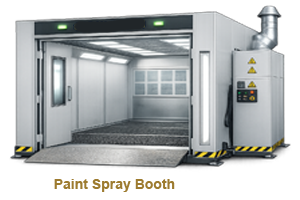
 At the epicentre of paint operations is always the spray booth, which can be either downdraft or crossflow. A proper spray booth provides controlled airflow, lighting, and temperature, creating an ideal environment for applying primers, basecoats, and clearcoats. Downdraft booths draw air vertically, offering superior overspray control and cleaner finishes, while crossflow booths provide effective ventilation in more compact installations.
Anyone who wants their classic car bodywork to remain in pristine condition for decades ahead, having their vehicle sprayed in a paint booth is essential for achieving smooth, defect-free finishes.
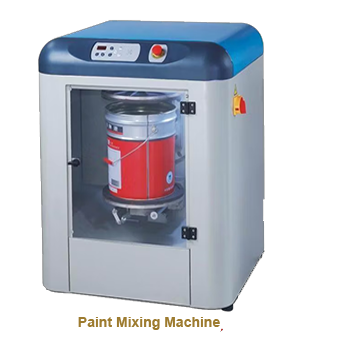
 Supporting paint application is the paint mixing room, which provides a clean, organised space for preparing coatings. Accurate mixing of paints, hardeners, and thinners is critical, especially when matching historic colours or working with specialist coatings. A dedicated mixing room improves consistency, reduces contamination, and enhances safety by isolating volatile materials from the main workshop.
Effective air quality management relies on a paint extraction and filtration system. These systems remove overspray, vapours, and particulates from the painting environment, protecting both the finish and the technician.
 Fitting proper filtration will ensures that airborne contaminants are not allowed to settle on freshly painted panels, while, at the same time, helping classic car restoration and maintenance workshops meet health and environmental regulations.
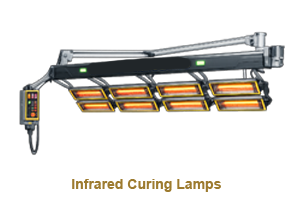
Curing is another critical stage in bodywork painting, and having infrared curing lamps (fixed rails) on site will provide significant advantages. Infrared lamps accelerate paint curing by heating coatings from within, reducing drying times and allowing work to progress efficiently. Fixed rail systems provide even coverage over large panels, minimising the risk of uneven curing or solvent entrapment—particularly important when applying modern coa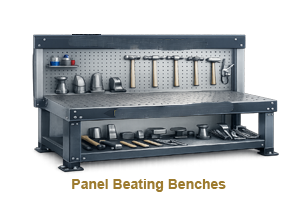 tings to classic panels.
Structural accuracy underpins all bodywork, making the body alignment jig / chassis jig indispensable, by allowing the vehicle body or chassis to be mounted and measured against factory specifications, thus ensuring that structural repairs restore correct geometry.
In classic car restoration, where accident damage or corrosion may have compromised previous attempts at alignment, having access to a jig will ensure that doors, panels, and suspension points align correctly before finishing work begins.
 Traditional methods of metal shaping should be supported by panel beating benches that provide stable surfaces and integrated tooling for shaping and repairing panels. These benches enable precise hammer and dolly work, essential for correcting dents and refining hand-formed panels without excessive filler. For preserving originality, skilled panel beating remains a cornerstone of quality restoration.
>Access and ergonomics are greatly improved by the rotisserie (body shell rotator). Rotisseries allow complete body shells to be rotated, providing safe and comfortable access to the underside for welding, seam sealing, and painting, particularly valuable during full restorations, where underbody work is extensive and precision is required.
Maintaining cleanliness throughout bodywork processes depends on a dust extraction system. Sanding, grinding, and filler work generate fine dust that can contaminate paint finishes and pose health risks. Effective air extraction will improve air quality, reduce clean-up time and play a major part in the ongoing efforts to maintain a controlled environment across the body shop.
 Final surface refinement should always be implemented in dedicated areas for flatting and polishing paintwork known as wet sanding bays. Wet sanding bays are designed to manage water and slurry, preventing contamination of other work areas, ensuring that final paint finishes are smooth, uniform, and ready for polishing to a high standard.
Having the most efficient bodywork, paint and finishing equipment at their disposal will enable a classic car restoration and maintenance workshop to deliver results that should match if not exceed original factory quality, arriving at the highest standards of consistency.

- Vehicle Lifting and Support Equipment
- Compressed Air System Equipment
- Electrical and Power Infrastructure
- Welding and Fabrication Equipment
- Metalworking and Fabrication Equipment
- Cleaning, Degreasing and Preparation Equipment
- Engine and Mechanical Workshop Equipment
- Bodywork,Paint and Finishing Equipment
- Sanding, Preparation and Rust Control Equipment
- Tyre, Wheel and Suspension Equipment
- Fuel, Cooling and Fluid Handling Systems
- Exhaust and Emissions Equipment
- Electrical and Diagnostic Equipment
- Storage and Workshop Furniture
- Safety, Environmental and Compliance Equipment
- Comfort, Workflow and Support Infrastructure
-