
Restoring and maintaining the electrical systems of a classic car are often regarded as one of the most challenging aspects of the industry. Ageing insulation, corroded connections, obsolete components, and non-standard modifications accumulated over decades can make fault-finding difficult and time-consuming. Dedicated electrical and diagnostic equipment allows restorers to work methodically, safely, and accurately, transforming electrical restoration from guesswork into a controlled, repeatable process.
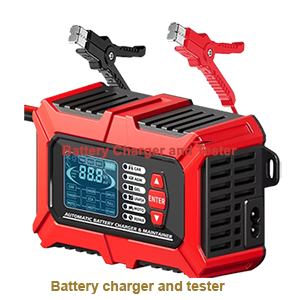 At the very foundation of auto electrical projects work is the battery charging station. By nature, classic cars are often stored for extended periods, meaning that their batteries will require careful charging to avoid damage. A dedicated charging station allows multiple batteries to be maintained simultaneously under controlled conditions, ensuring correct voltage and current delivery, supporting reliable starting during testing while preventing premature battery failure.
Closely related to the battery charging station is the conditioning unit, which offers significant advantages for older battery types that are commonly used in classic vehicles. Sulphation is a major cause of reduced capacity in lead-acid batteries, and conditioning units can often restore performance by breaking down sulphate build-up, making the battery conditioning unit especially valuable when preserving period-correct batteries or maintaining vehicles that see infrequent use.
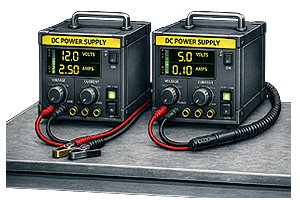 During bench testing and component development, bench-mounted power supplies provide stable, adjustable voltage and current. These supplies allow circuits, gauges, motors, and accessories to be powered safely outside the vehicle, means that auto-electrical faults can be diagnosed without the risk of damage to the vehicle’s wiring or battery, while components can be tested individually under stable conditions.
 The ignition testing bench is an essential diagnostic tool, as ignition systems are critical to engine performance. Classic cars often came fitted with mechanical distributors, points, condensers as well as early electronic ignition systems that require a very precise setup. Having an ignition test bench means that distributors can be adjusted, tested and timed at operating speed, ensuring correct advance curves and reliable spark delivery before installation, greatly reducing the need for troubleshooting and repairs once the engine is running.
 Charging systems in a classic car a major source of problems. Problems which can be diagnosed and even alleviated using a dynamo/alternator test rig. The role of the dynamo/alternator test rig is to enable accurate assessment of output and regulation, and their efficiency. Many classic cars are fitted with dynamos or early alternators, which behave very differently than from modern units. Having access to a test rig allows these components to be rebuilt and verified under load situations, ensuring they deliver correct voltage and current without overcharging or underperforming.
Starting reliability depends on the condition of the starter motor, and the starter motor test bench provides a controlled way to assess performance. By measuring current draw, torque, and engagement behaviour, restorers can identify worn brushes, bearings, or windings before reinstalling the unit. This prevents repeated removal and installation—a significant advantage when working on tightly packaged classic engine bays.
 One of the most valuable tools for full electrical restoration is the wiring loom test board. Classic car wiring looms have often been reduced to a fragile state making them difficult to access once installed. Having access to a test board allows looms to be laid out, checked for continuity and powered safely before installation. Faults that occur, such as broken conductors, incorrect connections or faulty earths can be identified early, dramatically reducing troubleshooting time later in the build.
Beyond individual tools, the overall advantage of having dedicated electrical and diagnostic equipment on call is increased confidence and consistency in the auto-electrical workshop. Faults that once required hours of trial-and-error can be isolated quickly using structured testing methods, as components can be tested and proven on the bench before installation, reducing the risk of damage to freshly restored or maintained vehicles.
From a workshop efficiency perspective, the ability to access in-house electrical diagnostics reduces reliance and costs of working with external specialists while allowing restoration schedules to remain under direct control a factor that is especially important when working on long-term projects where electrical systems may need to be revisited multiple times during assembly and testing.

- Vehicle Lifting and Support Equipment
- Electrical and Power Infrastructure
- Welding and Fabrication Equipment
- Metalworking and Fabrication Equipment
- Cleaning, Degreasing and Preparation Equipment
- Engine and Mechanical Workshop Equipment
- Bodywork,Paint and Finishing Equipment
- Sanding, Preparation and Rust Control Equipment
- Tyre, Wheel and Suspension Equipment
- Fuel, Cooling and Fluid Handling Systems
- Exhaust and Emissions Equipment
- Electrical and Diagnostic Equipment
- Storage and Workshop Furniture
- Safety, Environmental and Compliance Equipment
- Comfort, Workflow and Support Infrastructure
-